


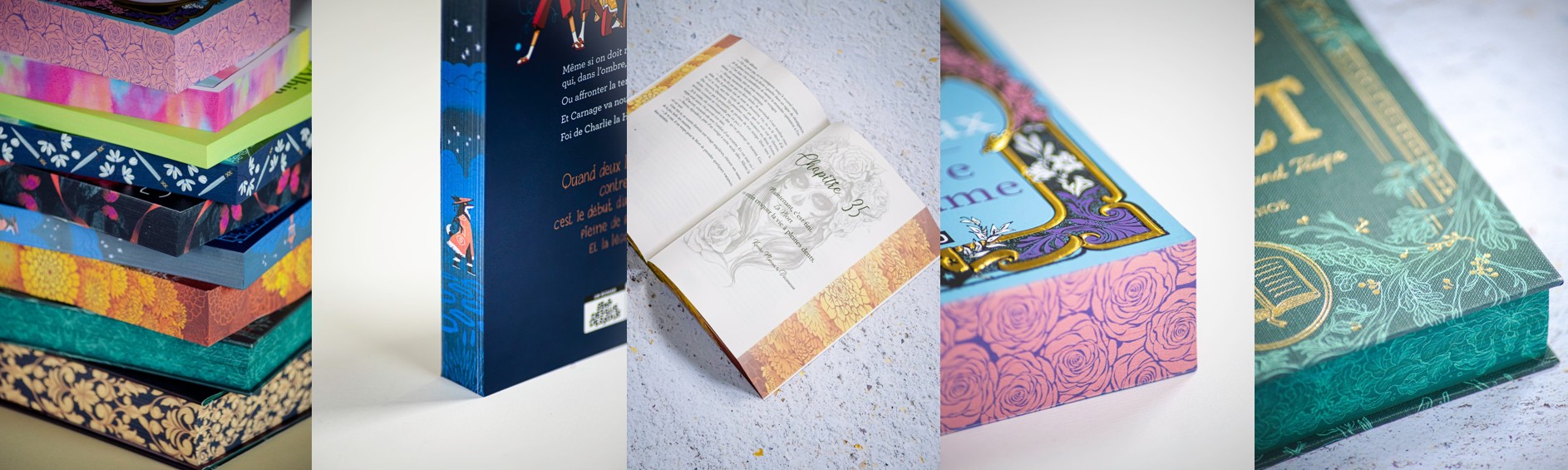
There are books you simply cannot resist picking up.
Sometimes it’s the title. Sometimes the cover, an eye-catching belly band, or a striking display. But in certain cases, it’s a part of the book that is usually neutral that captures our attention and draws us in: its edges.
When used effectively, four-colour edge printing — widely and generically referred to today as “sprayed edges” — has the power to give a book a distinctive identity and strong visual appeal.
A technique with historic roots
Sprayed edges date back to the 16th century. Originally, this artisanal technique involved projecting ink onto the edges of the pages, creating speckled or marbled effects.
Bookbinders of the 17th and 18th centuries saw it as both an aesthetic gesture and a practical one: protecting the page edges from wear and stains. At the time, edges were typically speckled, marbled, or covered with a layer of gold or silver.
Over time, this sensitivity to the book edge as a creative space gradually diminished, before making a spectacular comeback in recent years — now expressed in far more diverse forms than ever before.
The revival of sprayed edges, driven by New Romance and Fantasy
If edge printing has experienced a true resurgence in recent years, it is largely thanks to the New Romance and Fantasy genres.
These literary categories, supported by highly active reader communities on social media, have turned illustrated edges into a strong visual signature. They extend or complement visually rich covers and have become essential to an overall aesthetic often characterized by illustrations, patterns, and bold colours — all powerful purchasing triggers widely photographed and shared on Instagram and TikTok (BookTok).
Here, books are not just read — they are collected, displayed, and proudly showcased.
The phenomenon quickly moved beyond romance alone. Frequently used for collector’s and premium editions, edge printing is now appearing across a wide variety of publishing sectors, driven by a shared conviction: a book is also an object, and that object deserves to be designed down to the smallest detail to enhance its appeal and desirability.
A space for creative expression
The edges of a book offer a highly expressive surface that can be explored in many ways:
Extending the cover
The cover illustration or pattern continues onto the edge, creating a surprising visual continuity. When the book lies flat with the cover visible, the edge completes the image, transforming it into something almost like a case waiting to be opened.
Creating a collection identity
For a series or collection, each volume can feature its own colour or pattern while remaining visually coherent with the others. Aligned on a shelf, the books form a harmonious whole that reinforces the collection’s graphic identity.
Affirming a strong visual universe
For art books, illustrated titles, or reference works, printed edges contribute to the staging of the object. A typographic pattern, a texture, or a deep background colour can elevate the book into a precious object.
Surprising in unexpected genres
Literary fiction, essays, children’s books, graphic novels, practical guides… Edge printing belongs to no single genre. In fact, it is often in categories where it remains rare that it creates the strongest impact.
Edge printing at SEPEC
Four-colour edge printing is carried out after binding, once the book block has been assembled. The block is held tightly closed, and the edges are digitally printed (inkjet), delivering colour fidelity and detail levels capable of reproducing complex visuals, photographs, and fine illustrations.
At SEPEC, this finishing process is integrated into a fully in-house production chain and performed on a state-of-the-art digital printing system, enabling us to handle print runs of several hundred to several thousand copies.
This premium enhancement solution is available for both paperback editions (without flaps) and hardcovers.
We support and advise you from the creative concept through to the finished product. Paper type, shade and weight, binding method, and any specific characteristics of the book — all these parameters must be considered from the design stage to ensure the best possible result.
A detail that makes all the difference
Edge printing is that extra touch of character that transforms a book into an object people want to touch, examine, and display.
At a time when physical books must assert their value more than ever in the face of digital alternatives, paying attention to every production detail is not a luxury — it is a statement of intent.
Interested in exploring this finishing option for your next project? Contact us or request a quote online.